Sunday, September 4, 2011

Wakatobi - A Place We'll Never Forget

It's difficult to write about our time in Wakatobi because so much happened over the 9 days we stayed there! I have attempted to organise my writing chronologically by describing our experiences, the people we met and the things we saw to create a picture of this amazing place. This entry deals with our time in Wakatobi while the next will describe all of the cultural events we went to. 
Wangi Wangi harbour has many of these old, beached ships.
At the rally briefing back in Darwin we had been impressed by the presentation about Wakatobi by the regent of this cluster of islands just off the south-east corner of Sulawesi. His PowerPoint presentation included amazing photos of corals and a beautiful woman wrapped in various coloured sarongs. We were promised 100 litres of free diesel and a wide array of cultural events. Our curiosity was piqued and we decided to investigate.

Anima safely at anchor (until the wind blew up, we dragged and moved to a mooring), we tied up our dinghy at a huge facility that would suit ferries and cruise liners. The locals had constructed a wooden platform complete with stairs to allow us to get ashore with ease. A new building at the end of the pier staffed about a dozen Indonesians who were working for the W.I.C. Their job was to help us enjoy Wakatobi. Another dozen teenagers were volunteer guides who wished to practice their English as they helped us locate whatever we required. We were so impressed with the level of assistance we were provided with during our stay here. Rally yachts next year and any other cruising yacht travelling through the area should definitely check this place out!! 

Andrew, Novi, me, Siti and Penny.
Chess is big here and the guides or random locals sitting near the W.I.C building were almost always seen playing the game. Rene of course played a few times and was beaten in every match! They're good!! 
Rene playing chess against a master!
On our first day we set about our errands, exploring and organising. We took our empty diesel jerry cans ashore, a huge bag of laundry (this time the price was 10 000 per kilo) and rubbish. Robyn and Wal explored the village of Wangi Wangi with us and a few guides. One of my first impressions was to compare this village to Banda – the main differences I noticed were that the cats are not looked after in Wangi Wangi (they all look so unhealthy and are usually spotted pawing through rubbish) whereas the chooks and roosters looked much bigger and healthier here! The dust here is white rather than black, the local kids only know a few words in English and the prices are better here! There are night markets, morning markets and day markets all filled with women selling veggies, eggs and bananas.  
Penny at the local day markets
There's also a supermarket here whose main product seemed to be various types of chocolate milk (Milo is big here – it's even available in cans – I tried it but was disappointed that it was just milky Milo as I thought it would be carbonated). Rene was more adventurous (surprise surprise) as he tried drinking a popper of Mung bean drink. It tasted a bit like Japanese Lotus cakes. 
mmmmmmm..... ?
Everywhere we go, we're met with a chorus of “Hello Meestrrr!!!” and kids waving and smiling. The women look at me, full of curiosity and say things like 'inda chantik' (you're beautiful). Many women (and some men) walk around wearing a thick, white substance on their faces. We discovered it is to try and promote skin-whitening. It looks quite strange and a bit alarming sometimes when the paste is falling off or is smudged and smeared. White skin is considered beautiful. The soap stars and officials from Java who we met and saw during our stay here were all much paler than the local villagers here. 
Painting one's face white is considered beautiful here.
White-painted eyes are common.
On the 27th of August, it was a special day in the Ramadan month. Muslim's believe that the 27th is the day when the K'oran descended to earth. To celebrate, the more orthodox believers dye their fingertips bright red (I didn't figure out the significance). 

Everyone uses the end of Ramadan to pretty themselves up. People get haircuts and buy new clothes to wear on the first day after the month of fasting. Home-owners were also seen painting their buildings (lime green, pink and blue are popular colours). Women bake heaps of sweets and cakes and everyone starts dreaming of being able to eat and drink again. 
Diabetes anyone? They love sugar here!!
Every night there is a display of fireworks for Ramadan. On one night we were returning from dinner at Pelangi restaurant and the fireworks started exploding right over us!! They were being set off from a building about 30 metres away. The locals don't even flinch – but Robyn and I quickly took shelter under an awning by instinct. Some of the yachties bought their own fireworks, setting them off from their yachts at night with lots of yahooing and excitement. I decided to try out the local fashion by buying a veil or 'jilbab'. I think it suits the locals more than me! 
Trying out the local fashion...
On our second day in Wakatobi, we hired motor bikes with Robyn and Wal. Rather than pay for a guide to accompany us, we set out on our own with no maps - just a sense of adventure. It cost us 100 000Rp to hire a bike which we doubled on (it was cheaper to hire them in town but we wanted to support the W.I.C). Rene drove and I sat at the back trying to keep my helmet on which didn't actually tie up. First we filled up with fuel. I'd seen glass bottles sitting at stalls lining the roads and wondered if they contained juice. They're actually unleaded fuel for 7000 Rp a litre. The seat of our bike lifted up and the fuel was decanted in with a funnel. 
Robyn & Wal fill up with fuel
Petrol stations look like this in Wangi Wangi!
As a related point, part of the “deal” with rally yachts coming to Wakatobi was that we would each receive 100 litres of free fuel. We all took advantage of this extremely generous offer but felt a bit strange about doing so. The offer came from someone official in government who is working hard at boosting up tourism in this region. They really want the area to become a first-class tourist destination. The issue with this offer is that (as one of the locals told me), the villagers themselves have never once been given anything for free from the government. Another issue is that some yachts simply came to Wakatobi for the fuel. They stayed long enough to get it and then left again - barely giving the community anything back in return. I think the fuel offer could have been a smaller amount (and would have still attracted a similar number of yachts) such as one or two jerry cans (20-40 litres).

Motorbike riding is made interesting here due to the numerous pot-holes and variable road surfaces. Rene was continually having to swerve to avoid holes, other riders, children and chooks. We set off south through small villages and came to a thin, bumpy, steep forest track with a cliff-face plummeting down below. At the summit we came to a village with an interesting rock wall formation. Rene became our language guru as he began communicating with a small group of locals, trying to ask if it was OK for us to explore the unusual stone structure. One man decided to look after us and we followed him through a small cemetery, up into the stone (on closer inspection, these stones were actually lumps of coral rock) fort. At the top was a square space enclosed by frangipani trees rustling in the breeze. In the centre was shrine of sorts with three small clay lumps all covered in old cloth and wearing caps. There were offerings of flowers and food in small bowls too. Rene and the local struggled to communicate to each other, the complexities of such a place using our Bahasa Indonesia – English phrase books. The gist of it was that this was the centre of a large fort, “Lokasi Benteng” in “Liya Togo” village, and the offerings were to the dead king's wife... we think!
Phrasebook communication
We set out again down through the village and into another one that was by the sea. Again Rene started practising his Indonesian – this time with a man who came out of the house we'd pulled up in front of, by the name of Saharuni. He was a community facilitator in this village, Liya Bahari Indah Lagundi, and had pretty decent English, too. They continued chatting while we wondered off to explore the picturesque jetty and Agar Agar plantation / drying farm. The sea was a brilliant bright blue, covered in line upon line of seaweed farm. The lines are held buoyant with small plastic water bottles and pieces of broken Styrofoam. The local boats are carved from big trees, their anchors are either bits of broken coral or old machinery parts. Agar Agar seaweed was drying on wooden platforms and inside a small house above the water were a family sorting through nets.  
Agar Agar drying
Agar Agar growing
When I returned to Rene he had arranged to buy some coconuts from another local – whose house we were now in front of. Saharuni helped us out with the knowledge that the correct price for coconuts should be 2-4,000 rupiah, and that the owner was charging too much with 5000. After a little negotiation we got down to 4000 (50 cents) – which would probably be the price a rich local would pay. As a rich local would, we viewed it as charity and agreed to get one for each of us. While the man was climbing the tree, Rene practised Bahasa Indonesia with the man who appeared to be the land owner. They found out that we were Australian, had been here for a couple of days and planned to stay another few days, that we were both 30 and didn't have any kids but wanted to travel for a little first (they found the fact we didn't yet have children the most confusing). By the time the coconuts were down and sliced open we had made some kind of connection. A great time was had by all the kids watching the silly tourists trying to drink coconut juice and getting it all over themselves (I realised that they find it hilarious due to our big Caucasian noses).  
There's so much juice in these coconuts!
Squashed nose = cause of much laughter with locals.
It was so delicious – perhaps the best we've had. When Rene tried to pay his attitude sort of seemed to say he didn't want us to pay for it, but Rene gave the agreed amount. He took us down the road to meet his wife, and we had a good old village photo shoot out and a yarn. He told us that there is a big event on at the fort tomorrow, some kind of kick boxing or capoeira (see Posepa'a, below). When we left, he made sure we took some extra coconuts because I think he felt bad charging so much.

After a fun but strangely awkward lunch back at Pelangi (meaning 'rainbow') restaurant we set out again – this time, north. The lunch was fun because we shared it with our new Polish friends who are crewing on a yacht. It was made awkward due to the death-stares we sustained from the two late-teenage wait staff throughout the whole meal. I figured it was due to their intense hunger and jealousy – Ramadan doesn't allow them to eat or drink during daylight. We decided to only eat lunch on Anima from now on to avoid bad feelings between the locals and us non-Muslim visitors. 

Myself, Rene, Robyn and Wal on our bikes - in front of Pelangi
We set out north through more villages and forest in search of a natural spring. We were told there was a sign for it but our idea of a sign is pretty different to what's here – there are no street signs, only the occasional miniature billboard (made of wood nailed together) with many words displayed in small font. So, we kept driving and exploring and stopped about a dozen times to ask locals where to go for Kotemala springs (each time we went to ask however, we forgot the name and had to look it up!). Rene continued to excel at the language while Robyn, Wal and I either tried to mime or add in the occasional word to help. We drove all afternoon until our bottom's hurt from the bikes bumping along the uneven roads but it was glorious! After hours of unsuccessful searching, some locals took pity on us crazy tourists and showed us the way – it was quite different to what we were expecting. The natural spring turns out to be the local washing spot. It was filled with kids swimming, teenagers jumping and doing tricks, teenage girls (fully clothed) washing their hair and a woman with her laundry! Rene nearly got in too but was put off by the layer of oily scum on the water's surface.  
Kotemala Springs - Wangi Wangi
That night we dragged Penny from her sickbed and had a contented evening onboard Robyn and Wal's boat, Annwn. They very generously shared the last of their good cheeses with us so we drank wine and learnt more about each other. I love this aspect of cruising – getting to know all sorts of lovely people!! I think the socialising aspect is in fact my favourite. We had plenty of fun times with the crew from Kelolo, Annwn, Narid, Honalee and many more. We ate out almost every night at local restaurants for between 20 000 and 35 000 Rp each, including a non-alcoholic drink (about $3).
James, Sam and Wal -  sundowners on the good ship Kelolo.
Eating out at a local establishment with fellow yachties.
Wakatobi is renowned for its pristine coral grounds – we'd heard that even the drop-off near where our yachts were moored was worth a snorkel (unfortunately I didn't take my camera this time – sorry!). So one afternoon Penny and I swam over to Kelolo (about 20 metres away) and then we all (including Robyn from Annwn) swam together to the shallow sandy coral area before the drop off. This is the area where we'd observed local fishing boats chasing fish by slamming long bamboo poles into the water. It was low tide when we swam over, so there was only about 50cm of water. We had to swim through seaweeds that grew up almost to the surface (shudder!) and over sand (I was imagining sting rays being startled and stinging me Steve Irwin style). We saw lion fish and giant star fish coloured in reds, oranges and yellows with spikes! I also saw a moray eel and then was stung by something invisible on my leg so I took a deep breath and swam quickly to the drop off. It was pretty spectacular considering how close it was to a major village. There were lots of small fish and plenty of colourful corals. Sam found a large toad fish that looked like a death panda-fish and I had a go at swimming down to the corals, equalising my ears as I went. The only problem that I was getting stung all over my body, continually. I tried to ignore it – like everyone else but eventually my neck was stung so bad that I had to get out. I powered back over the shallows and across to Kelolo's dinghy. Getting out I felt a little shaky (I'm not a strong swimmer) and my feet were numb. I had stings all over my body – especially my neck. When Sam and James returned, they saw my neck which was covered in red spots and took pity on me, driving me back to Anima in their dinghy. I tried dousing the stings in vinegar but it only made it worse. I ended up sitting in the cockpit, spraying fresh water all over my neck for an hour. It looked pretty bad and felt pretty terrible. After a few hours though, the red blotches had receded and I was still alive. I want to be more of a sea-going person but every time I get in the water, something gets me! I think I'll just have to wear my wetsuit or stinger suit more often – stinging creatures seem to love my skin. I think the reason why we saw such a prevalence of poisonous fish is that everything else is eaten.
A local boat glides by
Local ferry easily motors over the shallow reef.
We found Wangi Wangi island in Wakatobi to be phenomenal. We had such a fantastic time there due to the locals who devoted themselves to making sure we had a good, safe, happy time. They even threw a surprise party one night when it happened to be two yachties (and Gino's) birthdays. 
A local birthday dance party!
This place is really special and will only get better. We hope to return one day....
Being mobbed with hugs and English practice is common here!

Friday, September 2, 2011

Sailing to Wakatobi

We all felt a little queasy after the calm waters of Banda. A couple of doses of Stugeron set us straight though. This crossing we decided to implement a 4-hourly watch system. I had 6-10, Penny had 10-2 and Rene had 2-6. I thought it worked really well as I had the best shift (mostly due to the fact I still had a head-cold). After two days at sea, however, Penny came down with the Banda Bug and we swapped shifts. This wasn't good for me (ruined my sleep rhythm) but worked well for her (trying to get better). The whole trip took 3 days and 3 nights. We covered just under 400 nautical miles and averaged about 4.5 knots. Initially we set out with our lovely friends on Annwn (from Bundaberg in QLD) but – as usual – they soon overtook us and disappeared over the horizon. We maintained radio contact with them for as long as we could. The radio net we usually log into was eerily silent (we discovered later that it had moved back by one hour to follow local time in Sulawesi). 
Our friends on Annwn sailing past us!
Three days and nights followed of sailing Anima. There weren't many other ships about but we did see whales, dolphins, flying fish and birds. On the first night an Indonesian fishing boat changed course and steamed right up to us passing by a whisker in front of our bows. I had to adjust our course and was a bit worried about how close they came but it was fine. Our chart-plotter had a warning that this area was frequented by pirates and so my imagination ran wild (of course). On the last night there were frequent short words over the VHF radio on channel 16. Just one or two words said quickly and then silence. A local sailing boat with blue sails passed us quietly... were they now following us? Paranoia got the better of us and we turned off our stern light and only sailed with the tricolours showing. I spent my night watch in what we call a “Billi watch” named after our cat (who now lives it up on land in Brisbane). This kind of watch is characterised by lots of wide-eyed staring out to sea. Thankfully I didn't see anything but still had planned my escape which involved grabbing the epirb, inflatable pfd, water ration and flippers and jumping overboard!! Luckily I didn't have to implement this plan. On the last day we passed strange small rafts; the first of which was flying a small, tattered black flag! Pirates we thought? But no, there was no one in sight. Just birds and a raft. A few miles further and we passed another! This one had palm fronds spread out over it. We wondered what they could be? I thought they might have been ceremonial rafts that were set out to sea. I asked Gino (from Wangi Wangi) about the rafts and he explained that they were fishing traps – the fish are attracted to the bamboo. If this is true, the Indonesians are amazingly resourceful because the rafts were in over 3000 metres of water! Imagine the anchor chain/rope they require!! 
Pirate raft... fish attraction platform...?
We zig-zagged a bit and changed our mind about the exact destination based on the wind. This trip was our best sailing yet in Indonesia as it was still relatively fast but the swell was much reduced. There was even a decent rain shower so Rene and I were able to wash our salty locks using the run-off from the mainsail. Water is a precious commodity out here! We had assumed that it would be free but have instead had to pay for it at each location. So a luxurious activity such as hair-washing is put off until the last possible moment. The water from the mainsail was still pretty salty but washing hair under a running trickle of water was revitalising!  
Washing hair at sea.
As we neared Wangi Wangi island, we started to hear radio traffic with yachts we recognised and with something called the W.I.C. (Wakatobi Information Centre). Gino from this organisation called us to explain the entrance procedure to the lagoon. We motor-sailed up to the lagoon and he boarded our boat (from his dinghy) to lead us in through the shallow entrance. 
Gino leads us into Wangi Wangi harbour.
After anchoring Gino gave us an information pack about Wakatobi and explained that this island environmentally aware – we were not to discard rubbish over the side (not that any yachties do anyway!). After our sea crossing we were keen for a drink and a catch-up with friends. It was Carol's birthday from Freycinet (also my Mum's too!) and we had a fun night at a bright pink hotel complete with rats and 80's style video hits karaoke.

Sunday, August 14, 2011

Banda - A Difficult Place To Leave


We love it here so much that we plan on staying for a while. Anima arrives just before the peak number of yachts. I think there were at least 25 boats here at one point. The numbers have dwindled ever since and we are some of the last to leave.

Banda scenes - nice huh?
Captain Rene decides that we need to spend some time doing boat jobs – they are always building up around us and we don't always get a chance to do them. Penny gets into cleaning – feeling and looking just like a proper crew!
Penny is making Anima shine!
She cleans our spray dodger clears, scrubs the cockpit until it shines and polishes the brass knobs inside!! Rene fixes the headsail sheet that broke on passage. Then he learns how to use my sewing machine and sews up the inflatable kayak we got in Darwin. The outer shell is really sun-damaged and requires a lot of work. He had to re-sew it twice as on the first inflation, it tore again! The kayak/canoe has it's own personality – thanks to the sewing repairs, it is leaky, lopsided and a bit funny-looking. We're happy with it though for the meantime until I work again and can earn enough to buy a hard plastic version. I got to bake bread, biscotti and Chihiro's travelling cake! I also finished sewing the Spinnaker sock (finally) and did plenty of handwashing (as usual!). Whilst also helping out Ren and Pen with their jobs, lots of tidying up and sorting out charts. Looking after a yacht is a full-time job!

So, Banda. It's a tiny group of islands in the middle of the Banda sea tortured with a violent past due to the spice – nutmeg which originates from here. The Dutch wanted to reap the benefits of nutmeg which used to fetch a high price due to its supposed health benefits of warding off the bubonic plague. Banda locals were slaughtered and enslaved as a result of this greed and it was only in the last 30 years that they have become independent again. Now it's a peaceful group of islands which still produce nutmeg and other spices and their associated products. We have become especially fond of nutmeg jam, Kenari nut slice and cinnamon cakes (rolled flat biscuit the locals call 'Ramadan cakes'). 
A local stall selling produce made from locally grown spices and nuts.
A local guide called Barkri took us on a tour of a small nutmeg plantation. He didn't have the best English so I just enjoyed walking around the farm and having a go at picking the ripe nutmegs. They have a special scoop-like bamboo tool for collecting the spice which, when opened from its shell is really beautiful. The nutmeg nut is surrounded by a rich, red lace of another spice they call Mace. 
Sam shows us how it's done.
Nutmeg freshly picked from the tree by yours truly :)
At the conclusion of the tour, we were fed a lovely sugar-fest of local treats but I was most interested in the big pile of fresh, ripe bananas! (I've totally overdosed on these since arriving in Indonesia by the way!).
Banana love xx
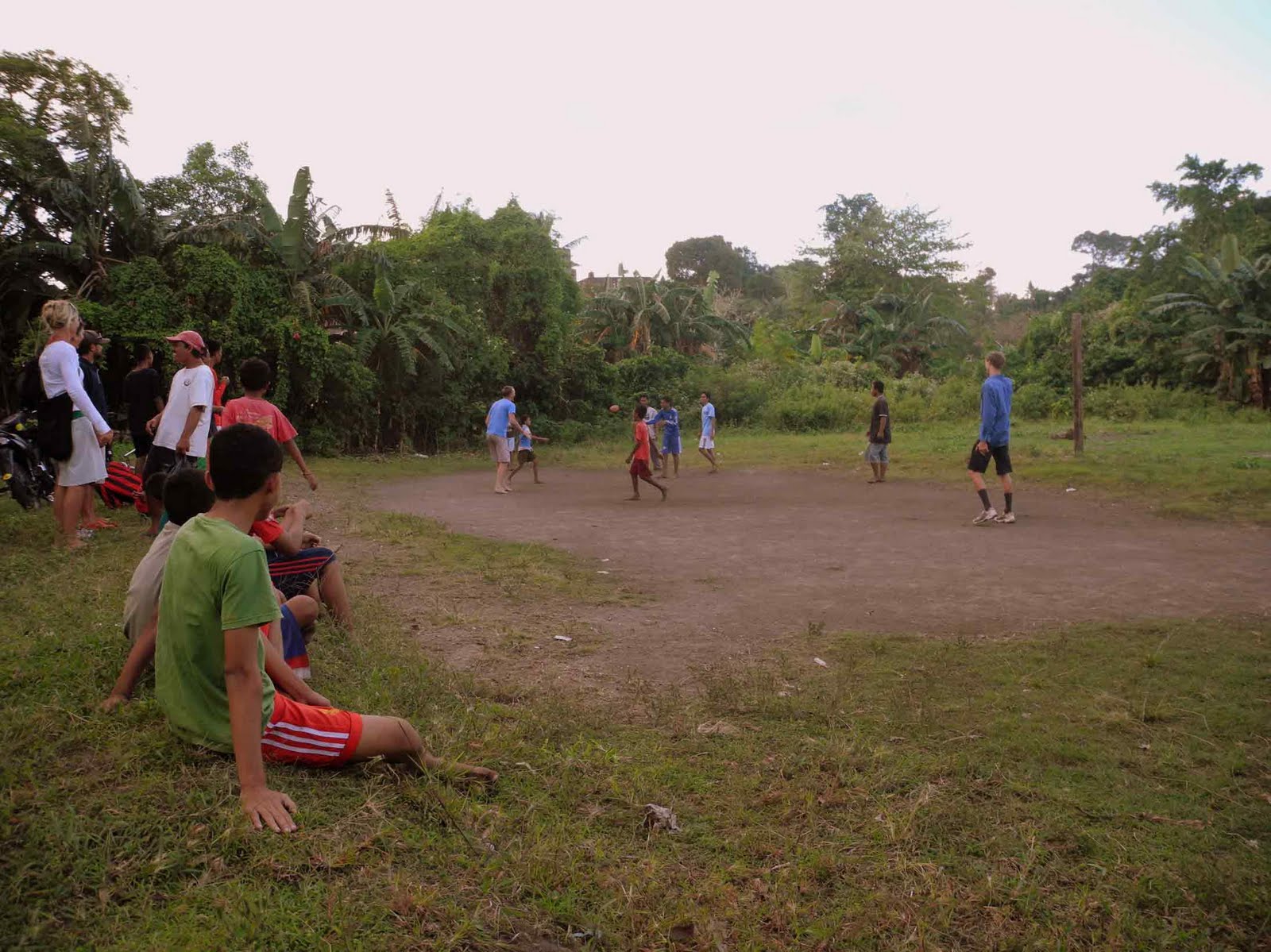
Rene was most into the impromptu game of soccer he and James (from Kelolo) joined with a bunch of local kids. He got plenty of laughs for his crazy foot tactics and silly acts.  
Can you spot James and Rene?
We'd been quoted that the tour was 50 000 Rupiah's each (just over $5AUD). We all dutifully paid over our cash at the farm but then at the end of the tour, back near the boats, Barkri wanted another fee – for him. We talked amongst ourselves and paid him about 20000Rp each. An amount he wasn't happy with. We weren't happy either! Us Australian yachties don't like tips and hidden fees!!
 
This became the common gripe of the rally's time here in Banda. Different yachts being quoted different amounts and then having to pay more upon the completion of the service. Rene and I decided to simply avoid all tours. It would have been interesting but we just can't fit it into our very tight cruising budget. We learnt that in Indonesia, it is really important to settle on the price before finalising the deal. Leaving things open leads to bad feelings when the price is higher than expected. Quite a few yachts were annoyed at the new fee of 100 000 that the harbour master issued to us as a clearance fee to depart here. We wonder how much of this fee goes to his own pocket? We were warned about a 300 000 clearance fee for Saumlaki that never happened, so we we take it philosophically.
This kind of small scale corruption is rife here. However, by all accounts it is a problem that needs to be tackled from the top down – normal people are just not paid enough, so that it is in most cases the way people are able to survive. According to the lonely planet, the former president Suharto embezzled 15 – 35 billion USD worth from Indonesia during his 30 year stint. People we have talked to are disgusted by the corruption and there seems to be a big groundswell against Suharto's friends in politics that could take shape over the next few years – they are prepared to fight for lasting change.
So. Bandaneira. This island is covered with cats, motorbikes and kids all wanting to practice their rote-learnt English introductions. A typical interaction is a child saying 'Hello Mr, my full name is...., my nickname is..., my call name is..., you can spell it...., my favourite colour, pet, sport, food is...., my parents names are... etc. etc.' with barely a breath between sentences! There are also plenty of bantam hens and roosters hanging about. Down one alleyway, Rene and I spotted a largish hen (they're all pretty scrawny) fending off an attack by a cat (equally scrawny) who wanted to eat the hen's chicks. We started trying to film the event and the owner of the house came out to see what we were doing. I gestured our intentions and they laughed before disappearing back inside their dark home (no one seems to use lights inside during daylight despite the houses being very dark). Only then did we hear the unmistakable sound of cats making love (not a very lovely sound!). Just beyond the bush we were standing at, there were two cats going for it! We felt horrible because it must have looked like we were filming cat porn to the owner – not our innocent chook vs. cat scenario!!  
Cats and bikes are common sights.
The entire population here is Muslim and their prayers are loudly broadcast many times throughout the day and sometimes all night. Because it's August, everyone is practicing Ramadan (a special annual religious event which involves fasting from all food and drink between dawn and dusk for a whole month). Ramadan is a bit like Christmas for Christians (minus all the consumerism) because it's a celebration. Every night there are people out on the street eating sweets and generally having fun. Home-made fire crackers go off almost constantly too. We discovered that the kids here are allowed to make and fire them during Ramadan (I think as a way to keep their minds off their stomachs). Because Bandaneira village is right opposite a huge volcano, the sound of the crackers reverberates loudly and sometimes sounds a little like gunfire. 
Ramadan fire crackers.
These crackers are not the only things burning – people burn their rubbish here and it's a very smoky environment. This wouldn't be so bad if they didn't burn everything – including plastics. The environment here is in danger if the locals don't figure out a way to stop pollution. The deep crystal clear water also contains plastic bag fish and other plastic junk, although it all gets swept away fairly quickly each tide (to Ambon!). There are programs afoot to educate the kids about rubbish and some of the yachties donated money towards getting some rubbish bins made here. We also met some awesome young people who are passionate about pre-emtively stopping over-fishing here and want to stop the corruption in government! Climate change/global warming isn't on the radar - with the current 'long term' plan being to build a garbage incinerator to power the town from, with a large chimney to keep the smoke away. I think they could do well building a geothermal plant off the volcano.

We went snorkelling a few times over a lava flow from Gunung Api's last eruption in 1988. The water is really clear which I find amazing considering the amount of rubbish and diesel that floats past in the harbour just a kilometre away. The corals growing on the lava flow were quite pretty but the best part was experiencing the water. Thanks to the active volcano, there are pockets of very warm, fresh water amongst the cold salt water. Visually, it looks like rippled glass or heat haze. I have set a personal goal to be able to dive down and swim around under the water rather than simply floating around at the top. So far I'm practicing getting the pressure in my ears to not hurt. As usual, Rene is like a seal in the water - he loved using Malonga's Hookah (battery operated air compressor) to dive down and stay down!
Rene snorkelling with Malonga's hookah
Volcano corals
Gunung Api is an active volcano that stands 666 metres tall (though the sign on top says 636 for some reason) and climbing it is one of the things to do while here. Penny climbed it before us with some other yachties and while they were sitting at the top having a snack, an earthquake rumbled and shook from deep within the earth! They climbed down quick-smart! I was in the internet cafe during the earthquake which mustn't have been very high on the scale as nothing broke and the volcano didn't erupt (thank God!). Local folklore is that the earthquakes or tremors felt here symbolise change in the weather. This did actually eventuate! The day after the ground shook, the weather was much warmer and sunnier for a couple of days. Coincidence?
One of the signs at the top!
The views are spectacular!
Rene and I managed to climb the volcano after many days of nearly making it but deciding not to. The climb was probably one of the most difficult I've ever done. The path leads straight up – nearly vertical – over scrambly, loose, falling rocks. It took me hours to climb to the peak as I had to basically crawl up using my hands to haul myself up and up and up.
Youngie came with us but powered on ahead somehow. We only caught up to him when he was on his way down! At the top, Rene set off some expired smoke flares hoping to cause some excitement to people down below.  
Rene on top of Gunung Api setting off his flares.
He rang our friends to tell them to look but they couldn't spot the orange smoke through the cloud-cover. The volcano is quite warm at the top – with smokey steam escaping through rocks and crevices. We ventured to the peak and peered over the edge. Surprisingly, there is an oasis inside the crater, filled with rainforest and small birds flitting about amongst the steam and smoke. 
The crater of Gunung Api
Sailbirds at the top of an active volcano!!
 We sat and had some trail-mix, feeling that sense of accomplishment you get after having scaled a mountain. Then we had a sneaky sinking feeling that perhaps we shouldn't be sitting here at the edge of an active volcano which, from memory, has quite a substantial overhang that perhaps we were actually perched upon! (which we were). The climb down consisted of sliding (almost like skiing on rocks, not snow) while trying not to fall over. I fell over at least a dozen times and have scratches, bruises and bumps to show for it. Rene and Youngie barely fell at all!

We're discovering that a place really opens up when we get to know some of the locals. For us here in Banda, this was facilitated through the captain and crew of Shady Lady. As I've mentioned previously, the anchorage here is a little difficult to negotiate alone due to the tricky reverse parking manouvre into tight spaces (many yachts don't reverse very well due to their prop walk - which basically means that they turn either to port or starboard rather than reversing in a straight line).  
Rene helps out Kelolo
As we arrived, we had help from a few yachties and Rene in turn helped out every boat that arrived after we did. He loves helping out and the crew of Shady Lady were most appreciative. Peter, Mark and Cathie from Shady Lady had sailed here from Ambon in pouring rain – tacking back and forth for 4 days in uncomfortable seas. They were very glad to have Rene helping out. Two days later, Rene helped out again – this time a large container ship was leaving the jetty (just 30 metres away) and its wake caused havoc amongst the yachts all tied together. Shady Lady was thrust up on the shore and she lost her VHF aerial in a tree. It took a few young men a while to free her and then more time to reposition her further away, in a safer spot. Then Rene dived under her and checked the hull for damage.  
Look how close the big ship is to the yachts!!
The crew of Shady Lady shouted us out to dinner at an amazing guest house called ABBAs. The décor was beautiful – lots of antiques, a waterfall, giant shells, nutmeg trees, lanterns and a white cockatoo! The food here is really amazing and we all ate very well that night! 
Dinner at ABBA's - AMAZING!
Cathie, Penny and Mark
The captain of Shady Lady is Peter Charles – a very experienced sailor who has for thirty-odd years, been coming here to Banda. He developed a friendship with the political leader of Bandaneira, Des Arwi and met a young man called Djufri at the age of 15. Peter brought goods here during his visits to help out the villagers and over the years has seen Djufri and maintained a friendship. 
Peter with Djufri

Peter with Djufri's photo at age 15
Djufri is a local teacher and guide who is very generous, intelligent and speaks great English. We visited his Muslim school one Sunday to give the students some gifts. The school is a simple room that is part of Djufri's house. His wife offered us Cinnamon tea and cinnamon cakes and we spoke to some of the students in a combination of English, mime and Bahasa Indonesia. The students are all very well behaved and gorgeous. Our gift of pens and pencils was issued out one by one to the eager students.  
Djufri distributing our gift of pens and pencils.
Cathie and Mark gave them jellybeans which they can of course not eat during the day during Ramadan. We were so impressed at the self-control of these kids. They all had a handfull of jelly beans which they just admired, smelt and swapped around. At nightfall, after their prayers, they would be allowed to eat the sweets. 
Swapping and comparing jellybeans
We had decided to give away our fibreglass dinghy to someone in Indonesia. It was useful to have a spare, but storing it was an issue. Every time a wave splooshed the starboard side, the dinghy (which was lashed outside) would go GAAAAADDUUUUOOOMPP!! and freak us all out. This continual action was damaging the fibreglass and also had worn away the paint on our hull! Djufri was so helpful and generous that we decided to give it to his family.  
Djufri and his sons row away in their new dinghy
Djufri's boys with their new boat.
In return, we were invited to dinner at his home one evening and were treated to his wife's amazing cooking. The best dish by far was a local speciality of eggplant covered with Kenari nut paste. YUM!  
Dinner at Djufri's
We were also able to fill a few jerry cans of water at his house for free as filling them up through the other options cost between 1500 to 20000 for 20 litres. Getting our tanks filled became a personal challenge for Rene who wanted to get the best possible price (ie. Free). We managed to get half a dozen jerry cans through Peter Charles who was staying in one of the rooms at the hotel we are tied up to. Then, once all but 3 yachts had left here, Rene negotiated with the harbourmaster to fill 16 jerry cans from the port's water supply for 60000Rp as a big ship was also filling up. Because the local water here is not drinking standard, I treated each of our 400 litre tanks. In one I used bleach (20ml for 400 litres) while in the other I tried out a special water purification product we bought in Darwin called 'Micropur' by the company 'Katadyn'. The water treated with bleach tastes a bit like tap water from any Australian captital city while the water treated with Micropur is like a public swimming pool that has just been chlorinated! It's un-drinkable! We think it will settle down after 4 days and become easier to stomach. I still wish we'd been able to afford a water maker (like so many other cruisers have nowdays) but they start at 2K just to buy, let alone install. We were impressed by one yacht, Just Magic, who have only used 100 litres since Darwin! They gave us some tips on how to save water and we've implemented some of them such as washing our dishes in boiled sea water and using a spray bottle of fresh water to rinse our faces of salt water. We keep hoping it will rain but so far there has not been a decent downpour to catch more than half a bucket of water.

Another local we've befriended is Mita, Des Arwi's granddaughter. Mita is bilingual and so we have been able to chat to her at length. She is a very motivated woman who is starting up an art school here in Banda among other things! I donated a bag of art supplies I don't use to her school. I also gave away an antique alphabet book to Jena, a local whose restaurant we've eaten at regularly for only 35000 each (about $3.70). Her restaurant is a room in her house, complete with her children walking past on their way to the mosque, cats jumping on our chairs to try and eat with us and home-style cooking that is so tasty (her mango juice is the bomb!). Jena taught herself English from a book someone once gave her and so I decided to continue her education and her children's with this old book that I've held onto and never used. I keep realising how little of the stuff we have, we actually need. It is so refreshing to give gifts to people who actually need them.

Over to Penny: ' I visited the local museum with Morshe (apologies the misspelling). We had to walk up the street to a private residence and wake up a sleeping lady named Ven who had the key. Although some of the artefacts in the museum were interesting, there was very little information about the objects and many of the objects were mislabelled. There were some fascinating 30cm high monkey statues made from volcanic rock sitting behind a large pot, there was no information about them and we were told they were Portuguese (which we thought was inaccurate). I wanted it as a garden gnome, but the museum wouldn't sell it. (Why can't people be corrupt when we want them to be?) The other object that interested us was a small round table that had a map and some cryptic Dutch writing etched into it. Again, there was no information about the table at all.

It is really sad to see how the heritage is not well preserved. Inside the main room of the four room museum, there is a hand-blown (possibly Venetian) glass chandelier, which is a bit broken and appears not to have been dusted in years. Many pieces of crockery are just stacked haphazardly in cupboards without any labels so you can't really see nor read what they are. On opening the drawers of the antique furniture, we were dismayed to find ice-cream sticks and candy wrappers. We took them out and handed them to the man who was in the museum with us (presumably a member of Feni's family), he simply put them back in the drawer. Some paintings and furniture had yellow paint on them from when the internal museum walls were repainted but no-one bothered to move the objects. We took umbrage to the request for a compulsory donation of 20 000Rp per person for visiting a museum when the money people are paying does not appear to go to maintaining it properly.' 
A Banda antique - opium jar?
Back to Cerae: Penny donated some ancient crockery she found on a beach nearby to the museum. We had heard good reports from other yachties that the local laundry service was worth it – so we gathered together a large garbage bag full of our sheets, towels and clothes and tried our hand at bargaining. My offer was a bag full of children's clothes and shoes for the washing. Getting this concept through took some time and negotiation and it still cost me 80 000 on top of the trade which I think was a mistake on my part. The laundry was returned the next day neatly folded but smelling bad and not entirely clean. I wanted to complain and have my sheet re-washed but realised that they would use the same detergent and the sheets would still stink so I didn't bother. I've been washing our laundry by hand again since then and not complaining so loudly.

There was a real party atmosphere here when all the yachts were tied up so closely together. Every night became a late one and some were more crazy than others.  
Jamming with some locals
We've met some nice folk here (both locals and cruisers) and have had a ball. I'm suffering for it now though with a headcold that I've coined as 'The Banda Bug' as it seems to be knocking out everyone! Nothing too serious though but it has waylaid our departure from this amazing spot.
Life's pretty simple out here :)
We plan on leaving tomorrow (health permitting), off the sea for a few more days to the Wakatobi island group on the south of Sulawesi. We could probably stay here another week but it's time to move on.

Saturday, August 6, 2011

Sailing To Beautiful Banda


 Rene felt a bit uneasy about the Lobobarese guy with a greedy attitude who had hung around too long at Wotap (we'd heard stories of boats being robbed at night in Indonesia, and had been particularly warned about the 'Muslim theives' from Lobobar village (albeit by Saumlaki Christians!)). We also worked out that it was going to take us longer than everyone else to sail to Banda (because Anima is slower). So, at 9pm we set out into the pitch dark, initially following our snail-trail on the chart-plotter and then following our course into the dark. There were some strange flashing lights about but we managed to avoid them all and then didn't see another vessel for 24 hours. Since arriving here in Banda, we've heard that Wotap has a bad reputation for stealing! One boat last year had more than 2K of gear nicked from their deck while they slept!! The police recovered most of it from a village in Wotap.

Prahu - a local sailing boat.
Now that Penny has learnt more about sailing, we arranged to each take 3 hourly shifts which worked out brilliantly. I'm much more well-rested as is Rene! During my shift in the early hours of the morning, black clouds rolled over and dumped rain on us (seems to be my luck!). Then, during Penny's shift, a big squall kicked up and the starboard sheet on the headsail broke! It started whipping around in the strong wind and rain as Rene stumbled out from his bunk trying to put the bed-sheet on as a sarong! Failing this, he ran out naked and Penny said lucky it was a moonless night! We got the headsail wound back in easily enough and then re-set the course – now under reefed main only. I logged into the radio sked for our rally and just as I was finishing, R2detour made some really funny sounds and stopped working. Now it was my turn to be up in the cockpit, wearing just my knickers and a skimpy singlet (no harness!!), hand-steering until Rene could get up and set up Aries the Fairy.
Wonderful crew Penny with hot pink Aries the Fairy!
Message in a bottle
After these dramas, the next day our sail was free of hassles – the only complaint was the rolly seas. We took turns sitting in the cockpit doing 15-minute watches for our 3 hours each. Penny and I wrote more messages in bottles and I somehow managed to wash my hair over the sink (a galiant effort in the big swells!). I also somehow managed to wax my legs (though not to a very high standard!!) as the boat lurched around. We all managed to get much more sleep than our previous crossings and it helped A LOT.

Trying to remain upright at sea.
The sea was lumpy and bouncy again. I'd been told that the deeper the water, the better the swell behaves. We were in over 6000 metres of water and yet the swell still knocked us about violently. I'm starting to think that the sea is rarely perfect and most yachties just put up with the discomfort of sailing in-between anchoring in amazing places (a small price some say). I'm much more used to sailing and being at sea but I still am in no hurry to make a long ocean passage!


Rene with Banda volcano
Eventually, after two nights at sea, the islands of Banda loomed on the horizon. As we neared them, we felt awe and excitement. This is exactly the type of place that I've dreamed about sailing to since beginning this lifestyle. Seeing a volcano up close is brilliant. I'm grateful for the HF radio yet again – without it, Chad from Just Magic wouldn't have been able to tell me the anchorage! We were planning on somewhere quite different. I climbed the mast again as we came through the leads. The water is crystal clear here. I saw no reefs, just plastic bags floating along in the water. The anchorage here in Banda is different to what we're used to. Thanks again to Chad, who motored out to us, explained the procedure and helped us execute it. Basically you have to motor in close to shore (still in about 20-30 metres of water), drop the anchor and reverse in towards the shore where you tie up with two stern lines. The palm trees here are covered in ropes holding the yachts in place, lined up together along the shore.


Port clearance was so easy here – taking only 5 minutes to hand over some forms. We love it here. The locals are really friendly and relaxed. The only harrassment we have experienced is the young children wanting to recite their rote-learnt English introductions. The streets are lined with drying nutmeg and mace while locals zoom about on their motorbikes and women work at market stalls selling spices, vegetables and sweets. A few times each day the muslim prayers echo out over the village. I quite like them as I can't understand the words so it just sounds like music.
Rally yachts tied up here in Banda.